Showing posts with label finances. Show all posts

Monday, March 03, 2008

Business Skills Every Creative Needs to Know, Now!

Last week’s HOW’s Newsletter was packed with business related articles for all designers! These articles contain basic information about the design business in general. True, some of them apply only in the US, but they’re worth a read nevertheless.

Among the different titles you can find:

• Designers' Hourly Rates See what other designers in the country are charging for their work and how they determine those rates.
• Make The Most of Downtime At Work When work gets slow, here are 6 ways to use that extra time to your advantage.
• Are You Ready To Freelance Full-Time? Look at our checklist to find out!
• Be Your Client's Best Friend 8 ways to keep clients happy.
• How to Motivate Every Type of Creative Get specific ideas for encouraging—and getting the best from—any designer.

There are about 90 articles to choose from, so browse around!

Saturday, May 05, 2007

Designers beware: 5S Phase 5, Shitsuke (Improve)

Welcome back to my series on 5S, the methodology to improve organization, order and cleanliness. In this article I cover the fifth phase, Improve. If you’ve made it this far, allow me to congratulate you!

But first, if you’re seeing this article and haven’t read the previous four:
Introduction to the methodology
Phase one, Select
Phase two, Organize
Phase three, Clean
Phase four, Standardize


Phase five, Improve

The purpose of this phase is to maintain the achieved conditions and establish new goals for improvement. When you improve you:

- Keep the order that you achieved during Seiton.
- Items return to their assigned place.
- Hardware and workstations are cleaned regularly.
- People enjoy a great work environment and are proud of their places of work.


And the steps:

Step 1: Redefine
You’d establish a standard, right? Now go back to the questions you asked yourself during phases 1 and 2 and ask them again against your current standard. Is there anything that can be done better? Something that doesn’t need to be in the work space?


Step 2: Document
Once you’ve gone through the questions again, see if the standard changed. If so, document again, take a new picture and post it in a visible place.

Here is a picture of the final standard for my desk, though I later on replaced the CD burner for an internal drive. Where are the pens you ask? Neatly stowed away in the drawers.


As a bonus, here I’m showing you a picture of my current desk, still applying the 5S philosophy.


This is my pencil box. It includes only what’s needed. Black, blue and red pens, a pencil, a highlighter and a calendar (Though now that I think about it, does the calendar need to be there? I have one in my computer dashboard… hmm…)


Step 3: Audit
Ok, so by now everybody in the organization has their standards. It’s time to audit their implementation. How to measure and evaluate progress is really up to the team and the criteria they want to apply.

Here’s an example I’ve used to audit offices. We did it weekly, for about a month.

Criteria to evaluate in each step:

Select
I haven’t selected anything (Earns 1 point).
I’ve selected some things (Earns 2 points).
I have only what I need (Earns 3 points).

Organize
I haven’t organized anything (Earns 1 point).
I’ve organized some things (Earns 2 points).
Every item has and is in its place (Earns 3 points).

Clean
I haven’t cleaned anything (Earns 1 point).
I’ve cleaned some things (Earns 2 points).
My work place is clean (Earns 3 points).

Standardize
I haven’t standardized anything (Earns 1 point).
I’ve established the standard (Earns 2 points).

Improve
I’ve improved the standard once (Earns 1 point).
I’ve improved the standard twice (Earns 2 points).
I’ve improved the standard three times or more (Earns 3 points).


Here’s an example of an Excel table to record and count the points:
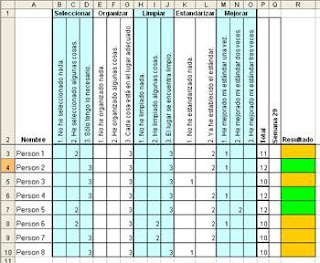

After counting the points the person gets a card:

Red card, if the person earned between 5 and 10 points. There’s big room for improvement here.

Yellow card, if the person earned between 10 and 12 points. There’s still room for improvement.

Green card, if the person earned between 12 and 14 points. The work space is very neat and clean!

The idea is for the cards to be displayed in the work area so that maybe a little competition between the people in the team sparks up to get to green in the four weeks of the audit process.

And that’s it for this phase and for the 5S!

It’s a good idea to repeat the audit process in a few months, to see if the team keeps the new conditions.

I hope you’ve enjoyed this series and that your workplaces are areas of productiveness and pride!
All the best!

Tuesday, August 08, 2006

Designers beware of… technology and supplies.

When running a design office or a design department, you need to assess the kind of equipment you'll be needing and the supplies you'll be using on a daily basis.

If you're starting out, you need to decide the extent of your operation, research the types of activities you'll be performing, so that you can assign a budget for your equipment. Try to figure out how long it'll be before you have to update your hardware and software and take this into consideration when managing your current budget and the budget of the upcoming years.

Also, beware that technology changes too fast in these times. Subscribe to a technology magazine or newsletters and be constantly aware of new developments that can make your work easier of more efficient, or new things that you can offer to your clients. A great one for we designers is Macworld (www.macworld.com). Joining a few technology forums in Ecademy or other platforms is also a great way of being up to date and asking people around for the latest and greatest.

Less expensive items like general office supplies also need to be accounted for. Measure their use and unless you have an unlimited budget for this, try to recycle and get the best of them. You don't always know when you're going to run out of printer cartridges or glossy paper.

All the best!

Designers beware of… customer service.

Something to think about in any business is your relationship with your clients. We designers often think that the world doesn't understand us, that clients don't speak the design language… think again: It is we who need to understand them and speak their language.

Speak their language you ask? It's not as hard as you think, I found that mainly the secret is to listen. Take the time to sit down and find out what your client expects from you and vice versa.

The tracking system I mentioned in my previous blog will be one of your best allies, because you'll always have information for your clients at hand, you'll know exactly where each project is, if it's been invoiced, sent, what the terms where, etc. Accurate information is very valuable to clients and it'll be a differentiating point against your competition.

Also, when the project is in the client's hands, make sure you follow up on them, let them know that you're available to answer any questions and that you care about what they have to say. If you can, attend some negotiation seminars and learn the way to handle tough customers. It is important to learn how to say no as well, and guide your clients towards the best design solution, one that they're happy with and that doesn't compromise your principles.

Remember I told you about speaking the language of the clients? Well, you need also to be aware of the way you speak, this means, grammar, spelling and the way you present ideas. This is particularly important when sending emails and explaining design issues in writing. It is very easy for a customer to get confused when he receives an email and it's not well written.

Revise how much detail you want to go into when discussing matters with your clients. Little detail and you won't be able to convey your message, too much detail and it's likely that your counterpart will get confused. Grammar and spelling do speak about your professionalism, so be aware of the image you're presenting. Check emails for errors or typos before sending them and make sure your staff does the same.

Do call your client on a regular basis to let them know that status of a project. They should never have to call you. Be strict about meeting deadlines and exceed your customer's expectations.

Remember, the clients are the ones bringing in the money, so treat them as you would like to be treated, put yourself in their shoes… you will find that many times your clients become your friends and your best referrals.

All the best!

Designers beware of… finances.

Money is involved in everything (Well, almost). Design is no exception. When it comes to design, you need to be aware of the costs you have when you're "designing" in order to be able to reduce them, to establish prices, to establish goals and to check if you're operation is actually bringing back some cash.

Along with costs, you need to be aware of your sales and how those are related to the costs you have. In order to "be aware" you need to measure, as my former boss used to say: "What you don't measure, you don't know". In order to measure, you need to establish some data collection, a database or some sort of system that will allow you to keep track of your projects, what went in, what came out. In the beginning I used to do this using File Maker, but a basic Excel table will do. You just need to be disciplined and enter the information rigorously.

So, in short:

- Set up a tracking system, not only to keep track of your design traffic, but to keep track of your costs and sales.

- Measure how much you're spending in the operation (Yes, including the coffee you drink).

- Measure how much you're selling.

- Establish some goals, like reducing costs and increasing sales.

- Follow up and review periodically, about once a week or twice a month.

If you're a flying solo designer, this operation is rather simple, though you may want to get some advice from an accountant or some finance professional.

If you're part of an in-house design department, you need to be aware of your operation and its performance related to the whole company. The finance department is usually happy to help.

If you have your own design studio, consider hiring a financial advisor, but don't leave all up to them, get involved.

All the best!