Early in my career I was faced with the challenge of being in charge of a section of the company I worked for which included having a person reporting to me. I remember feeling completely scared of becoming a bad boss!
At that time I consulted with a colleague of mine who’d had a lot more experience and he gave me a few pointers. In the end, his best advice was “just be yourself”.
So I became G’s boss.
G happened to be very receptive from the start as we were both learning all the technical aspects of the job.
In the beginning it was hard to get him to see the bigger picture, to plan ahead, he couldn’t imagine how he could predict the events and therefore, the actions to be taken for the upcoming weeks.
But during the five plus years that G and I worked together we both grew professionally to a point where we achieved autonomy in ourselves but presented results as a team.
This was an amazing growing experience and led me to want to continue to grow as a leader.
I recently was faced again with another “being the boss” challenge. Two girls reported to me. One fresh-out-of-college designer and another one with a bit more experience.
This posed a bigger test because I had to use different languages to speak to each of them.
Since my experience with G had been so good and we’d grown together at the same pace, I thought I could just use the same method with anybody.
Not!
Miss F, the fresh-out-of-college designer needed me to hold her hand a bit more, to walk her through the steps of the different activities, to guide her. And she would usually come back to me with “What do I do now, Carolina?”
And I found myself resisting the urge to give her a straight answer. I had to get her to think, to come up with solutions by herself, to be more independent every day, to ask me less.
In the eight months that we worked together she came a long way and could do most of her work all by herself. I was very proud of myself and her.
The other girl, Miss Q, she had a bit more experience and wasn’t afraid to speak her mind. Also, she was strong-willed and assertive. This demanded a different approach from me, one where the ideas would mostly come from her, with a little guidance from me.
This also resulted in a great growing experience; the more I demanded from her, the more she would give and the more she came up with new ideas and solutions.
I have a point, I promise…
Sometimes designers end up becoming creative directors or managing a small group of creative people, which may not be something they ever saw themselves doing.
So here are a few tips to be more effective in that arena:
Be yourself, really. As I’ve said in a previous post, it’s not about barking orders or being in a position of power. It’s about getting the best of people and people will give you their best when you are authentic, honest and real.
Be clear about goals and expectations. Communicate them frequently.
Spend some time trying to figure out what the other person is about, what their mental process is, how they handle information, so that you can figure out the best way to get through to them.
It’s not about them adapting to you or following your lead, but quite the opposite. It’s about you stretching yourself to find the most effective way to get the best out of your team and have some fun while doing it!
I am so looking forward to more leadership challenges in the future, as they are the most interesting part of my work!
Mi idea with this post is that designers think outside of the box and start reflecting on the direction their career can go in the future and if they want to be in a leadership position. If so, start preparing.
Read some books about personal leadership, building teams, managing people and resources… Become aware. There’s a lot of information on the web, podcasts and books.
Epilogue: G went on to take my position and is now the design leader there. Miss F and Miss Q continue to work in my previous company, where they are faced with bigger challenges everyday. The both insist that I was a great boss ;-)
All the best!
Sunday, June 03, 2007


12 resume writing tips for designers
Looking for a job? Finding a new design position can be a very daunting and stressful experience, especially if you're a fresh-out-of-college designer applying for your first creative job.
In my recruiting experience I've found that most young designers in South America and Colombia would benefit from some guidance with regards to self-promotion.
So if you're fresh out of college, or a senior designer straight out of a long career, here are twelve top tips for designers' resumes that can help you land that all-important interview:
I hope these tips help out a few designers out there.
For more resources visit:
I look forward to receiving some comments.
All the best!
This article is a revision on a first version I posted a while ago. Thanks to Wayne Smallman, technology blogger and fellow designer for revising the english version of the original article.
In my recruiting experience I've found that most young designers in South America and Colombia would benefit from some guidance with regards to self-promotion.
So if you're fresh out of college, or a senior designer straight out of a long career, here are twelve top tips for designers' resumes that can help you land that all-important interview:
- Do some research
Even if you think you know everything there is to know about designing a document, use your design know-how to effectively present your resume.
There are tons of websites with information about designing a CV (Curriculum Vitae) like Rita Sue Siegel Resources, for example.
Now, being a designer, most likely you're expected to show your creative side in your resume (At least I expect that.)
Nevertheless, this is a document for you to show that you're a professional and therefore, all the right information must be included, even if it means sacrificing that beautiful symbol you want displayed throughout the whole document.
So your flair for design is there only to enforce the information in your resume. Always remember: style over substance is a big no-no! - Customize your resume to match the position
Designers can work in different areas of design. I've seen this especially with graphic designers.
If the position calls for an illustrator, make your resume reflect that in the jobs or projects you want to show.
If the position calls for a web designer, then include all web work you've done with links (making sure those websites are still active!) If you think something else will add to your value proposition, include it.
However, don't try to squeeze all your work experience in just one page if some of it has no relevance to the position. - Make it a one-page resume
Yes, all necessary information can fit in one page, as weird as it sounds.
You have to think that the person receiving your resume is receiving a lot more and she probably is printing them out to read at her leisure (i.e.: when she has the time.)
Make her job easier by including all pertinent information in a single page; you will earn some extra points for that.
Now, you're a designer, play with typography, space, color… it's also very important to make sure the information is presented in an organized, clear, easy-to-read way and have some fun! Make your personality and style show through. - Proofread your resume
Don't forget to double – better yet, make that triple – check your document for typos and grammar errors. Nothing says “unprofessional” like a sloppy resume.
Set time side and get someone else to read your resume through for you. Maybe your mom, your dad, a friend maybe – anyone, so long as your resume is proofread. - Highlight your name and contact information
Your name and your contact details are the most important part of your resume!
Make them stand out by placing them where they will be easier to read for the recruiter: most likely the right top corner of the page, or top centered.
Do include all your contact information, telephone numbers (cell included) where you can be reached for sure.
If your email is something like “big_stud@hotmail.com” it's better to get a new one, just your name and last name, something that identifies who you are.
I personally think that it's not necessary to include your photo, though I've seen some pretty cool ways to add a picture of yourself as an illustration or an unusual treatment in Adobe Photoshop.
If you're applying for a job as an illustrator, this could be a good way to highlight your resume and maybe stand out from the rest. - State your profile
Include a brief paragraph expressing what your profile as a designer is, or what your major, or preferred areas of expertise are and what short-term goals you have.
This helps the recruiter see quickly if your profile matches what they're looking for.
Additionally, try not to talk about the long-term in a way that sounds like you're just using your prospective employer as a stepping-stone in your design career. - Add the professional experience information
Include your work experience, listing jobs in reverse chronological order. For each job include:- The time period (the date when you started and when you finished) for that job, including year and month.
- The responsibilities of your design position.
- The achievements of the position, and how they translated into either an increase in sales or the reduction of costs for the firm. Add some numeric information, when possible.
If you've worked as a web designer, or have links to your work on the Internet, make sure they work properly and contain all updated information. - Add the academic information
Include the qualifications you have and filter them to be pertinent to the position you're applying to.
Also list your qualifications in reverse chronological order, too.
Be sure to include the year in which you graduated and the title you received. - Make sure you send the right file
When sending your resume file through email, take into consideration:- Check that your file is complete. Yes, I've received resumes that only list the jobs, with no name or contact info, because the person forgot to include the previous pages!
- Here's another chance to stand out by naming your file with your name, e.g.: “carolina_ayerbe_CV.pdf”; make the work of the recruiter simpler and make your design resume easy to find among all the files she's downloaded that are called “CV.doc”, “resume.pdf” and every other file name that doesn't provide any information as to what it contains.
- Include your name, title and the position you're applying for in the subject line of the email.
It makes it easier to find you in the long list of emails the recruiter receives every day. - Write a short, warm and assertive email message to go with your attachment. This will effectively act as your covering letter.
Don't just send the attachment alone; some people might take this gesture to be rude. Say hello, at least. Be polite!
Don't underestimate the value of a well-crafted message selling the benefits the company will get by hiring you.
If necessary, go back to the Tip 1 and do some research on how to write a proper resume covering letter. - Don't lie
Most recruiters can see through a liar. Show your work in a dignified way, talk about your accomplishments, but don't try to sell things as more than they really are.
I once received a CV from a designer who'd presented himself as a “brand creator”. Hmm, interesting, I thought.
When I interviewed him and asked him how he went about creating a brand, it became obvious the guy had no idea what he was talking about. We both wasted our time.
Be honest about what you've achieved as a designer. It's much more effective. - Combine your resume with your portfolio
I really like it when the resume includes some examples of the work the designer has done.
All contact, work and academic information should be in the first page.
From the second page on, it's a good idea to include three or four examples of your best work. This will be the entrée for the recruiter to ask for a more complete portfolio from the designer.
Don't send twelve pages, though. Still keep it short, two or three pages maximum. - Be professional
Most young designers aspire to rise to the level of a professional. Design is a business; it's not just about the perfect decoration in the pretty resume. I'll say it again: style over substance is a big no-no!
It has to convey a message of professionalism, that you can actually do the job and that you know how to speak the design language inside a business setting.
I hope these tips help out a few designers out there.
For more resources visit:
- Rita Sue Siegel Resources
- Manager Tools (Resumes)
- Manager Tools (Resumes and interviews)
- Search2u
- Or subscribe to The Career News, a newsletter with tons of tips to boost your job search.
I look forward to receiving some comments.
All the best!
This article is a revision on a first version I posted a while ago. Thanks to Wayne Smallman, technology blogger and fellow designer for revising the english version of the original article.
Sunday, May 27, 2007
Design magazines
As I’ve discussed before, I think young designers in Latin America would benefit from expanding their scope and trying to find new and wider sources of information. One of those sources are design magazines. Though the web has opened up many doors for designers, there may be some that will read this information for the first time.
Remember how I said that I used to think that my world was really small? Well, when I was at the university I used to think that design magazines were beyond my reach. In those days there was a really beautiful one called Abitare, italian, awesome… we used to see them at the design building’s library.
As years went by, I started working and got a credit card and what do you know…? Using credit cards, you can buy things abroad! I don’t know about you, but this never occurred to me when I was in college (I know, I know… I was either too innocent, or didn’t have good friends!).
So I wanted to let you know about two magazines I’ve been subscribed to for years.
 How Magazine: This magazine focuses on graphic design, which being a designer, I love. And it shows some great examples of graphic design, they have contests and then they feature the winners and the contestants, so it’s a great source of visual culture.
Furthermore, what I really love about this magazine is its business edge. You will find design business related articles, from hiring an accountant for your design studio, to how to boost creativity and be a great design leader.
They also do a “Business Annual” every year (no kidding, huh?) that covers even more business related topics like salaries and legal stuff. To me, this magazine is a must read for every designer. It’s American, but I think it conveys the global design business trends of today.
 ID Magazine: Sister of How Magazine, ID focuses more on my field, industrial and product design. It doesn’t have the same depth in business issues, but it’s a great showcase of the best of current design. I suggest you get this one too.
So my message for this short post is…
1. Get a credit card! I don’t care if you’re a student, banks always have special promotions for you.
2. Research and subscribe to design magazines. If there aren’t any good ones in your region, subscribe to a couple abroad!
3. Even if you can’t afford it, research local publications. It also doesn’t have to be on your design discipline, you can check some decoration magazines, or architecture… it’ll all become what I call “visual culture”, feeding and stimulating your brain with more design!
I mean, that’s why we became designers, isn’t it?
Hey, do leave a comment if you want to suggest more magazines!
All the best!
Remember how I said that I used to think that my world was really small? Well, when I was at the university I used to think that design magazines were beyond my reach. In those days there was a really beautiful one called Abitare, italian, awesome… we used to see them at the design building’s library.
As years went by, I started working and got a credit card and what do you know…? Using credit cards, you can buy things abroad! I don’t know about you, but this never occurred to me when I was in college (I know, I know… I was either too innocent, or didn’t have good friends!).
So I wanted to let you know about two magazines I’ve been subscribed to for years.
 How Magazine: This magazine focuses on graphic design, which being a designer, I love. And it shows some great examples of graphic design, they have contests and then they feature the winners and the contestants, so it’s a great source of visual culture.
Furthermore, what I really love about this magazine is its business edge. You will find design business related articles, from hiring an accountant for your design studio, to how to boost creativity and be a great design leader.
They also do a “Business Annual” every year (no kidding, huh?) that covers even more business related topics like salaries and legal stuff. To me, this magazine is a must read for every designer. It’s American, but I think it conveys the global design business trends of today.
 ID Magazine: Sister of How Magazine, ID focuses more on my field, industrial and product design. It doesn’t have the same depth in business issues, but it’s a great showcase of the best of current design. I suggest you get this one too.
So my message for this short post is…
1. Get a credit card! I don’t care if you’re a student, banks always have special promotions for you.
2. Research and subscribe to design magazines. If there aren’t any good ones in your region, subscribe to a couple abroad!
3. Even if you can’t afford it, research local publications. It also doesn’t have to be on your design discipline, you can check some decoration magazines, or architecture… it’ll all become what I call “visual culture”, feeding and stimulating your brain with more design!
I mean, that’s why we became designers, isn’t it?
Hey, do leave a comment if you want to suggest more magazines!
All the best!
Wednesday, May 23, 2007
Gracias, Merci, Thank you, Danke, Grazie, Obrigada!
Last year I started writing about the design business as part of a networking strategy I was implementing. At first I thought I didn’t have much to say…
So I wrote about eight articles that were first posted on Ecademy. Late last year I got prompted to write again by a friend and that’s how I’ve been posting weekly all this year. I discovered I actually had some things to say!
So, technically, I am an amateur blogger, a newbie, a rookie…
Still, I’ve gotten such a positive response so far and I find amazing that people from all over the world visit my blogs both in english and spanish. I am aware that many of those visits are mere coincidences, but I’ve noticed I’ve got some regular visitors. So this post is to thank all of you who have visited, have left comments and continue to visit!
People from Australia, Bangladesh, Bolivia, Bosnia and Herzegovina, Brazil, Canada, Chile, China, Colombia, Ecuador, Finland, France, Honduras, Hong Kong, India, Iran, Italy, Japan, Macedonia, Malaysia, Mexico, Morocco, Netherlands, Norway, Peru, Portugal, Qatar, Singapore, Spain, Sri-Lanka, Sweden, Switzerland , Turkey, United Arab Emirates, United Kingdom and USA have visited me during these months and I am so grateful for it…
So what’s in store for the future?
I will be starting at a new job soon. I’m not sure yet how my work load is going to be, but I intend to keep posting weekly. This new job represents a huge challenge for me and I’m sure it’ll give me plenty of topics to talk about! I am so excited about it!
I also intend to make some changes to optimize the blogs, maybe shorter titles, maybe more pictures, a new template? I don’t know. Actually, why don’t you tell me what you’d like to see?
Thank you again and I hope to see you around!
So I wrote about eight articles that were first posted on Ecademy. Late last year I got prompted to write again by a friend and that’s how I’ve been posting weekly all this year. I discovered I actually had some things to say!
So, technically, I am an amateur blogger, a newbie, a rookie…
Still, I’ve gotten such a positive response so far and I find amazing that people from all over the world visit my blogs both in english and spanish. I am aware that many of those visits are mere coincidences, but I’ve noticed I’ve got some regular visitors. So this post is to thank all of you who have visited, have left comments and continue to visit!
People from Australia, Bangladesh, Bolivia, Bosnia and Herzegovina, Brazil, Canada, Chile, China, Colombia, Ecuador, Finland, France, Honduras, Hong Kong, India, Iran, Italy, Japan, Macedonia, Malaysia, Mexico, Morocco, Netherlands, Norway, Peru, Portugal, Qatar, Singapore, Spain, Sri-Lanka, Sweden, Switzerland , Turkey, United Arab Emirates, United Kingdom and USA have visited me during these months and I am so grateful for it…
So what’s in store for the future?
I will be starting at a new job soon. I’m not sure yet how my work load is going to be, but I intend to keep posting weekly. This new job represents a huge challenge for me and I’m sure it’ll give me plenty of topics to talk about! I am so excited about it!
I also intend to make some changes to optimize the blogs, maybe shorter titles, maybe more pictures, a new template? I don’t know. Actually, why don’t you tell me what you’d like to see?
Thank you again and I hope to see you around!
Sunday, May 20, 2007
Designers beware: Podcasts
Last year I went to New York and bought an iPod, 60GB, black. Even though I was a bit disappointed in the beginning, I caved in to it, I love it and now I can’t live without it.
Anyway, this post is not about iPods. It’s about me missing out on a wonderful source of knowledge and inspiration for years!
As you probably know by now, I am a huge Harry Potter fan and after J.K. Rowling appointed Mugglenet as the best HP site, I was addicted to it. Some time in 2005 Mugglenet started podcasting with Mugglecast, and I discovered the wonderful world of podcasts, radio-like shows you can download to your iPod!
For those of you who, like me, have (had) been living under a rock for the last few years, keep reading! But of course, most of you will find this information redundant, I bet.
I use iTunes as my podcast aggregator, though there are several others out there. I don’t want to get too technical here, especially because I don’t fully understand how they work. What I can tell you is that using iTunes and clicking on iTunes Store>Podcasts, you can find podcasts about almost every subject imaginable, including, yes, you guessed it, design.

If you go to Categories at the left, and click on Arts and then go down a bit to More Arts, the first category is Design! And now it is your turn to explore. There are podcasts about many aspects of design, the different design disciplines…

 The Creative Venture
Host Tony Clark brings together the worlds of design and business. Though Tony stopped podcasting a few months ago, you can still download the 14 episodes which are full of great insight into the design business.
 Other podcasts I listen to are related to business. My favorite one is Manager Tools, where hosts Michael Auzenne and Mark Hortsman discuss about management issues. I’ve found that most of their advice applies to the design business as well.

 I also listen to podcasts related to leadership, finance and other topics in general.
Anyway, this post is not about iPods. It’s about me missing out on a wonderful source of knowledge and inspiration for years!
As you probably know by now, I am a huge Harry Potter fan and after J.K. Rowling appointed Mugglenet as the best HP site, I was addicted to it. Some time in 2005 Mugglenet started podcasting with Mugglecast, and I discovered the wonderful world of podcasts, radio-like shows you can download to your iPod!
For those of you who, like me, have (had) been living under a rock for the last few years, keep reading! But of course, most of you will find this information redundant, I bet.
I use iTunes as my podcast aggregator, though there are several others out there. I don’t want to get too technical here, especially because I don’t fully understand how they work. What I can tell you is that using iTunes and clicking on iTunes Store>Podcasts, you can find podcasts about almost every subject imaginable, including, yes, you guessed it, design.
If you go to Categories at the left, and click on Arts and then go down a bit to More Arts, the first category is Design! And now it is your turn to explore. There are podcasts about many aspects of design, the different design disciplines…
Here are a few comments about some I’ve listened to:
 The Accidental Creative
Host Todd Henry talks about being creative in an “on-demand” environment. Great ways to boost your creativity!
 The Accidental Creative
Host Todd Henry talks about being creative in an “on-demand” environment. Great ways to boost your creativity!
 The Creative Venture
Host Tony Clark brings together the worlds of design and business. Though Tony stopped podcasting a few months ago, you can still download the 14 episodes which are full of great insight into the design business.
 Other podcasts I listen to are related to business. My favorite one is Manager Tools, where hosts Michael Auzenne and Mark Hortsman discuss about management issues. I’ve found that most of their advice applies to the design business as well.
 I also listen to podcasts related to leadership, finance and other topics in general.
So now that I’ve given you a few pointers, it’s time that you go into iTunes and explore for yourself! Or better yet, find other podcast aggregators and try some! Explore different topics and subscribe to those that you decide you want to listen to on a regular basis. You’ll find that some podcasts are not worth subscribing to because they’re just not very good (like Design Matters with Debbie Millman) or that they just don’t relate to you.
The best part of all this knowledge being shared through podcasts is that it’s free, you can carry it around with you in your iPod or mp3 player, you can save it for later use… did I mention it’s free?!
If some of you can add to this article, let us know more information about podcasts aggregators or other interesting podcasts you listen to, please comment! I’d love to receive your feedback!
All the best!
The best part of all this knowledge being shared through podcasts is that it’s free, you can carry it around with you in your iPod or mp3 player, you can save it for later use… did I mention it’s free?!
If some of you can add to this article, let us know more information about podcasts aggregators or other interesting podcasts you listen to, please comment! I’d love to receive your feedback!
All the best!
Saturday, May 12, 2007
25 things about me
My friend Wayne Smallman from Blah Blah Technology recently did an article on 25 things about himself and I thought I’d follow his lead and roll with it…
So for once you get to know a little bit about me. Here goes:
1. My full name is María Carolina Ayerbe Castro, however nobody calls me all that. There are many shorts for my name, like Caro, Carito, Caroline, Carol, Carriolo…
2. There are two things I don’t like to talk about: Politics and religion.
3. My friends talk about the “relativeness of Carolina”. For example, I’ll say “I don’t like to dance, unless I have to”.
4. I don’t like to exercise (unless I have to, lol) in general. However I used to play tennis and started jogging about two years ago. I jog one day and work out the next.
5. I taught myself english when I was about 12 by means of closed captioning in TV shows.
6. My eyes tend to water whenever I’m talking about something serious.
7. I’d worn glasses since I was 9 until I was 26, when I had lasik surgery.
8. I have poor short term memory, which is really the reason why I create so many systems and databases to control everything and why I became so organized.
9. According to what I’ve researched, I was one year old when my first memory was created. It’s of my Mom taking me to the doctor.
10. I’ve always loved books. Books with lots of pictures, like design, architecture, science or art books.
11. I’m known for being honest and direct which, granted, has brought me trouble sometimes.
12. I am a HUGE Harry Potter fan, I lost count of how many times I’ve read the books and heard the audiobooks and I never miss an episode of Mugglecast.
13. Although I’m a latina girl, I enjoy rock and pop… though no mixes for me, I like the originals, thanks. Latin music is not for my iPod, it’s for dancing!
14. I love to travel. I’ve made it a goal to travel at least once a year.
15. I am fascinated by ancient cultures, especially Egypt.
16. I didn’t use to be a disciplined person, but in the last few years I’ve discovered true freedom in discipline.
17. My favourite color is red and I have to restrain myself from buying everything red.
18. I love to sing. I don’t have a good voice, but I’ll even sing to the commercials on TV.
19. I have no vices, except an addiction to chapstick and biting my fingernails.
20. I’m usually either too cold or too hot, but almost never quite confortable. Living in Bogotá (Colombia), most of the time, I’m too cold.
21. I love sci-fi, movies and novels and for a girl, I am quite interested in technology. I love gadgets and I will read their manuals thoroughly.
22. I never learned to skate and I wish I had. It looks like so much fun!
23. I love speed with safety, like rollercoasters… or just speeding up in the car (not that that’s safe at all).
24. When I smile, I get a dimple on my right cheek, but not on the left.
25. I love people who are passionate about what they do.
Phew! That was hard…
All the best!
So for once you get to know a little bit about me. Here goes:
1. My full name is María Carolina Ayerbe Castro, however nobody calls me all that. There are many shorts for my name, like Caro, Carito, Caroline, Carol, Carriolo…
2. There are two things I don’t like to talk about: Politics and religion.
3. My friends talk about the “relativeness of Carolina”. For example, I’ll say “I don’t like to dance, unless I have to”.
4. I don’t like to exercise (unless I have to, lol) in general. However I used to play tennis and started jogging about two years ago. I jog one day and work out the next.
5. I taught myself english when I was about 12 by means of closed captioning in TV shows.
6. My eyes tend to water whenever I’m talking about something serious.
7. I’d worn glasses since I was 9 until I was 26, when I had lasik surgery.
8. I have poor short term memory, which is really the reason why I create so many systems and databases to control everything and why I became so organized.
9. According to what I’ve researched, I was one year old when my first memory was created. It’s of my Mom taking me to the doctor.
10. I’ve always loved books. Books with lots of pictures, like design, architecture, science or art books.
11. I’m known for being honest and direct which, granted, has brought me trouble sometimes.
12. I am a HUGE Harry Potter fan, I lost count of how many times I’ve read the books and heard the audiobooks and I never miss an episode of Mugglecast.
13. Although I’m a latina girl, I enjoy rock and pop… though no mixes for me, I like the originals, thanks. Latin music is not for my iPod, it’s for dancing!
14. I love to travel. I’ve made it a goal to travel at least once a year.
15. I am fascinated by ancient cultures, especially Egypt.
16. I didn’t use to be a disciplined person, but in the last few years I’ve discovered true freedom in discipline.
17. My favourite color is red and I have to restrain myself from buying everything red.
18. I love to sing. I don’t have a good voice, but I’ll even sing to the commercials on TV.
19. I have no vices, except an addiction to chapstick and biting my fingernails.
20. I’m usually either too cold or too hot, but almost never quite confortable. Living in Bogotá (Colombia), most of the time, I’m too cold.
21. I love sci-fi, movies and novels and for a girl, I am quite interested in technology. I love gadgets and I will read their manuals thoroughly.
22. I never learned to skate and I wish I had. It looks like so much fun!
23. I love speed with safety, like rollercoasters… or just speeding up in the car (not that that’s safe at all).
24. When I smile, I get a dimple on my right cheek, but not on the left.
25. I love people who are passionate about what they do.
Phew! That was hard…
All the best!
Saturday, May 05, 2007
Designers beware: 5S Phase 5, Shitsuke (Improve)
Welcome back to my series on 5S, the methodology to improve organization, order and cleanliness. In this article I cover the fifth phase, Improve. If you’ve made it this far, allow me to congratulate you!
But first, if you’re seeing this article and haven’t read the previous four:
Introduction to the methodology
Phase one, Select
Phase two, Organize
Phase three, Clean
Phase four, Standardize
Phase five, Improve
The purpose of this phase is to maintain the achieved conditions and establish new goals for improvement. When you improve you:
- Keep the order that you achieved during Seiton.
- Items return to their assigned place.
- Hardware and workstations are cleaned regularly.
- People enjoy a great work environment and are proud of their places of work.
And the steps:
Step 1: Redefine
You’d establish a standard, right? Now go back to the questions you asked yourself during phases 1 and 2 and ask them again against your current standard. Is there anything that can be done better? Something that doesn’t need to be in the work space?
Step 2: Document
Once you’ve gone through the questions again, see if the standard changed. If so, document again, take a new picture and post it in a visible place.
Here is a picture of the final standard for my desk, though I later on replaced the CD burner for an internal drive. Where are the pens you ask? Neatly stowed away in the drawers.

As a bonus, here I’m showing you a picture of my current desk, still applying the 5S philosophy.

This is my pencil box. It includes only what’s needed. Black, blue and red pens, a pencil, a highlighter and a calendar (Though now that I think about it, does the calendar need to be there? I have one in my computer dashboard… hmm…)

Step 3: Audit
Ok, so by now everybody in the organization has their standards. It’s time to audit their implementation. How to measure and evaluate progress is really up to the team and the criteria they want to apply.
Here’s an example I’ve used to audit offices. We did it weekly, for about a month.
Criteria to evaluate in each step:
Select
I haven’t selected anything (Earns 1 point).
I’ve selected some things (Earns 2 points).
I have only what I need (Earns 3 points).
Organize
I haven’t organized anything (Earns 1 point).
I’ve organized some things (Earns 2 points).
Every item has and is in its place (Earns 3 points).
Clean
I haven’t cleaned anything (Earns 1 point).
I’ve cleaned some things (Earns 2 points).
My work place is clean (Earns 3 points).
Standardize
I haven’t standardized anything (Earns 1 point).
I’ve established the standard (Earns 2 points).
Improve
I’ve improved the standard once (Earns 1 point).
I’ve improved the standard twice (Earns 2 points).
I’ve improved the standard three times or more (Earns 3 points).
Here’s an example of an Excel table to record and count the points:
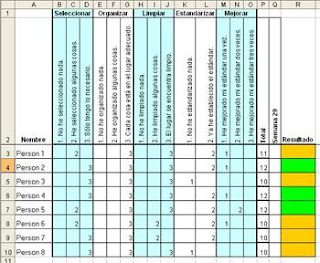
After counting the points the person gets a card:
Red card, if the person earned between 5 and 10 points. There’s big room for improvement here.
Yellow card, if the person earned between 10 and 12 points. There’s still room for improvement.
Green card, if the person earned between 12 and 14 points. The work space is very neat and clean!
The idea is for the cards to be displayed in the work area so that maybe a little competition between the people in the team sparks up to get to green in the four weeks of the audit process.
And that’s it for this phase and for the 5S!
It’s a good idea to repeat the audit process in a few months, to see if the team keeps the new conditions.
I hope you’ve enjoyed this series and that your workplaces are areas of productiveness and pride!
All the best!
But first, if you’re seeing this article and haven’t read the previous four:
Introduction to the methodology
Phase one, Select
Phase two, Organize
Phase three, Clean
Phase four, Standardize
Phase five, Improve
The purpose of this phase is to maintain the achieved conditions and establish new goals for improvement. When you improve you:
- Keep the order that you achieved during Seiton.
- Items return to their assigned place.
- Hardware and workstations are cleaned regularly.
- People enjoy a great work environment and are proud of their places of work.
And the steps:
Step 1: Redefine
You’d establish a standard, right? Now go back to the questions you asked yourself during phases 1 and 2 and ask them again against your current standard. Is there anything that can be done better? Something that doesn’t need to be in the work space?
Step 2: Document
Once you’ve gone through the questions again, see if the standard changed. If so, document again, take a new picture and post it in a visible place.
Here is a picture of the final standard for my desk, though I later on replaced the CD burner for an internal drive. Where are the pens you ask? Neatly stowed away in the drawers.
As a bonus, here I’m showing you a picture of my current desk, still applying the 5S philosophy.
This is my pencil box. It includes only what’s needed. Black, blue and red pens, a pencil, a highlighter and a calendar (Though now that I think about it, does the calendar need to be there? I have one in my computer dashboard… hmm…)
Step 3: Audit
Ok, so by now everybody in the organization has their standards. It’s time to audit their implementation. How to measure and evaluate progress is really up to the team and the criteria they want to apply.
Here’s an example I’ve used to audit offices. We did it weekly, for about a month.
Criteria to evaluate in each step:
Select
I haven’t selected anything (Earns 1 point).
I’ve selected some things (Earns 2 points).
I have only what I need (Earns 3 points).
Organize
I haven’t organized anything (Earns 1 point).
I’ve organized some things (Earns 2 points).
Every item has and is in its place (Earns 3 points).
Clean
I haven’t cleaned anything (Earns 1 point).
I’ve cleaned some things (Earns 2 points).
My work place is clean (Earns 3 points).
Standardize
I haven’t standardized anything (Earns 1 point).
I’ve established the standard (Earns 2 points).
Improve
I’ve improved the standard once (Earns 1 point).
I’ve improved the standard twice (Earns 2 points).
I’ve improved the standard three times or more (Earns 3 points).
Here’s an example of an Excel table to record and count the points:
After counting the points the person gets a card:
Red card, if the person earned between 5 and 10 points. There’s big room for improvement here.
Yellow card, if the person earned between 10 and 12 points. There’s still room for improvement.
Green card, if the person earned between 12 and 14 points. The work space is very neat and clean!
The idea is for the cards to be displayed in the work area so that maybe a little competition between the people in the team sparks up to get to green in the four weeks of the audit process.
And that’s it for this phase and for the 5S!
It’s a good idea to repeat the audit process in a few months, to see if the team keeps the new conditions.
I hope you’ve enjoyed this series and that your workplaces are areas of productiveness and pride!
All the best!
Subscribe to:
Posts (Atom)


