Sunday, November 25, 2007

Design on wheels

Tokio Showroom: Where is Japan going and what’s the future of the automobile?


That’s the title of last week’s Motor Magazine article article about the 40th Tokio Showroom, a showcase of the latest in car design.

Where’s colombian design when it comes to shaping the future of mankind? Well, I’ll let the link speak for itself (Beware it’s in spanish).

All the best!

Tuesday, November 20, 2007

Four Design Influences

As designers we pull from different sources to build our aesthetic awareness, our “visual culture” as a friend of mine used to call it. Here are four sources of design inspiration that I think can influence the way designers create, for the better.


Music:

Saturday night, a concert in Bogotá, the Iceland queen, Björk. She opens up the concert with a costume that made her look something like a mix between a mushroom and a jelly fish.

I was listening to the music and comparing the beats to the movements she made when she danced, how she expressed the music visually, with her body and how that connected with the stage design and the whole production including the other musicians and the different elements that were placed onstage that made for the visual experience of the performance. It was simply amazing.

There was another time in my life when this was very palpable. When I was in high school I had an art teacher. She once played some music for us in a boom box and asked us to draw what we felt. The results were rather interesting and varied, depending on the person. While some people drew in a linear form, others went back and forth with their shapes, up and down, changed colors.

Music has mountains and valleys, punches, speed, tone, it’s big or small, it’s very obvious or subtle, it can be deep, steep or narrow. Music can become something visual, something that has a shape, a size, even a color. And if it’s something visual, then it can be used to create design.


Food:

The other day I was watching Anthony Bourdain: No Reservations on TV and he was visiting this restaurant in Spain, called “El Bulli”, where his chef and owner Ferran Adriá has a very unique proposal to gastronomy.

It turns out that Adriá and his team believe in innovation in both the dishes they make as well as how they present them, that’s why they work on a lab a great portion of the year, as if it was a chemistry project.

His team includes an industrial designer who has two functions: One, to come up with the symbols that identify the internal processes in the lab and two, to come up with the best crockery and the best cutlery to present the different courses.

How cool is that? Can you imagine working as a designer for something that is not obviously design related?

Check out El Bulli’s website and go to the section called “1983-2005 general catalogue” and see the amazing shapes, the innovating dishes, the way it’s all presented, not only as an aesthetic proposal, but as a culinary experiment, using ingredients and combinations that nobody has dared to use.


Art:

This is, of course, an obvious one. How has art impacted design? What a big question! And nowadays you often can’t draw a line between art and product design. Who is to say that an iPod is not artful? And remember the Bauhaus? Where’s the line there?

To me, art is anything, any medium that is used to express human emotion. Would you agree with me if I said that product design (and any kind of design, for that matter) is influenced by emotion?

How does an art piece make you feel? And how do certain design pieces make you feel? Is there a connection? What elements can we take from art, to apply to design?


Other designers:

Here’s another obvious one, but do young designers actually take the time to research other designers in the world?

When I was in college, we reviewed the work of French Philippe Starck. Little did I know that the guy was still alive! I thought that since many of his pieces were modern design icons, maybe he was already dead. Silly me…

Anyway, this is a French designer that has designed some of the most representative pieces of modern industrial design, from culinary objects, to entire hotels! And there are tons of pictures of his designs on his website. This is a great source of inspiration, to see how design problems can be solved with ease and style.

The point here is to research, to find out what who the big designers are right now! What they’re doing, what trends they’re creating! And then ask ourselves, what do I bring to the table?


There are many other sources of influence for designers. As Latin American designers, are we tackling on all of them? Are we researching, acquiring visual culture? What other influences can you suggest? Books, movies, local culture, history?

All the best!

Tuesday, October 30, 2007

Time Tracking Tool

Like most designers, I hated Excel. Then one day the best boss I ever had (an engineer, by the way) introduced me to the wonderful world of spreadsheets.

Excel is a very powerful tool once you get to know it. I don’t know that much, actually, but I have developed a few tools to keep track of design traffic and time. Last year I wrote about time measurement and mentioned briefly how to go about tracking time and tasks.

Today I want to go deeper and share with you a tool I created to track the time and activities you do on a daily basis.

It’s pretty simple. With it you can:

· Establish categories for your activities.
· Know how much time you’re spending in such activities, and filter by category.
· Find out if you’re wasting time in meaningless tasks.
· Find out if there are tasks you can delegate, empowering your employees.
· Measure how much time you’re spending at the office.

Also, as I said in the article I mentioned earlier:

You may find that it's more effective to hire a consultant to take care of certain time consuming activities or you may even ask for your suppliers to absorb such activities which would make your operation even more effective.

You need to be aware of how long do your typical projects take, in order to have accurate planning, and how much to charge.

You can plan more strategically ahead of time so that you know if you need to get some outside help for that big project that will be coming next week or if you have some free time to spend on leadership activities with your staff. In other words, when you know how long will your projects take and how they're organized in any given time frame, you get a broader vision of your business.


So without further ado, here’s the tool and the instructions:

I call it my "Follow Up Activities" spreadsheet. You can download the Excel file here. This is the file as I use it, and this file has been filled for activities for five days, as an example, but feel free to adapt it to your needs!
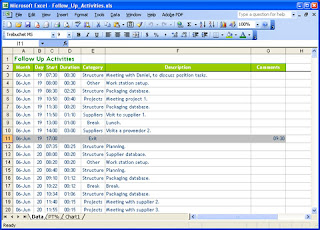
It’s basically a table with the following fields: Month, Day, Start, Duration, Category, Description and Comments.


Month: This is a text field. I like to name it "00-mmm" where “00” is the number of the month (for instance June would be 06) and “mmm” is the first three letters of the month’s name. Why? Because it allows me to sort by number of the month, instead of the name, so that January will always be at the top, for example.

Day: This is a number field. Type number of the current day.

Start: This is a date/hour field. Type the hour of the day in which that particular activity started, in 24 hour format.

Duration: It’s a date/hour field, with a formula where the duration of the activity is calculated by the starting time of the following task minus the starting time of the previous task. In the picture above the formula would be =C4-C3 for the first cell and then that is copied down on the cells of the D column.

Category: This is a text field. You define the categories of activities. In this example I’ve created seven categories. There’s one called “Breaks” where I record the times I spend on breaks and lunches.

Description: This is a text field. Type a description of the task. I use the same name for the same activity for example I always write “Packaging database” for that particular activity instead of using several different names for it.

Comments: This is a text field. If you wish to add something else like who you met with or if the project was billed, etc.


Now for some instructions:

· Data should be input by the minute, every time you change activity, you need to go there and input that information. This is key, and it needs to be done rigorously and with discipline. This way you always have current information and you're not stuck with having to type several days worth of information.

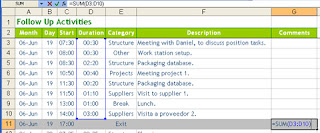
· The last activity of the day is called “Exit”. You only type the start time, but you must erase the formula in the “Duration” field for this activity.

· When the day ends, I like to use the “Comments” cell of the activity to add up the total hours I spent at the office that day. This is just a SUM formula that adds up the duration of all the activities. For instance in this particular day I was at the office nine and a half hours.


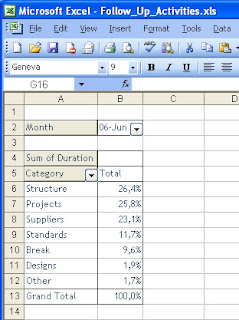
· There’s another worksheet in the Excel file, called "PT%", where I’ve added a Pivot Table report that will tell me how much time I’ve spent in each category or task. Pivot Tables are dynamic, and I can change the fields at leisure. For instance, instead of percentage, I can change it to hours.


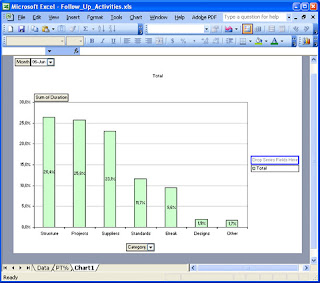
· And I’ve also added a graph to illustrate those times.


Neat, huh? Well, I think so. Do leave some comments if you have some ideas about how to improve this tool!

All the best!

Tuesday, October 23, 2007

Design resources: 2 articles

Here’s two articles I read this week from How Magazine, that I want to share with my readership.

Get A Life (And Other Remedies for Creative Atrophy) by Jenny Pfalzgraf.
When creative impulses are few and far between , designers often turn to outside sources for a boost. Whether it's hiking in the mountains, getting a tattoo or bringing your pet iguana to the office, this freedom to explore your inner child feeds your business finesse.

The Proof is in the Process by George Shaw
A teacher once told me, "Anyone can be creative on their best day. If you want to make a living at this stuff (graphic design), you've got to be creative on the days when your car breaks down and your wife leaves you." I thought he was trying to get me to listen to country music, but eventually, I figured out what he was talking about.

All the best!

Monday, October 22, 2007

Design resources: Coroflot.com

A place where designers gather together!


Coroflot.com is an online community dedicated to all the branches of design, where designers can promote themselves through:

· Uploading their resume.
· Uploading their portfolio.
· Joining groups (Like D Colombia).
· Searching jobs (Mostly abroad).
· Commenting on other designers work.
· Networking.

If you are a designer, then you need to be here.

I’ve actually used this site to recruit designers before, and every day it is becoming more and more popular in Colombia, so do take the time to post your information here. I’ve been a member for years.

As colombian (And Latinamerican designers) we need to stick together, help each other and promote latinamerican design. This is a great place to start.

Germán Salamanca had already commented on this site last year, however the site has had a revamp this year, so it’s worth it to check it out now and enroll if you haven’t already.

All the best!

Monday, October 15, 2007

Latin American Design Events

As a second post today, my friend Leonardo Mora told me about three design related events going on in Latin America.

Design Fest, in Guadalajara, México.

Latinamerican Design Summit, at University of Palermo in Buenos Aires, Argentina, already gone for this year, but coming up again next year.

Is it be possible for we colombians to organize events like these?
Or maybe our designers will join such events!

All the best!

How can I?

The other day I was listening to a radio show and one of the people cited a question that got me thinking about Colombian designers’ attitude towards design and work in general.

How can I…?

I don’t think I’ve been on the field as much as I would’ve wanted. Still, It’s no secret that I get this impression that many Colombian designers (and some Latin-American designers, maybe?) suffer from “third world” or “small” mentality, where we’re basically living and working by default.

This was especially evident when I went to the 10th Design Showroom at my university a few weeks ago.

So, they call themselves “lucky” if they can land a job. A job, which for the most part, is very poorly rewarded in our country. I think it’s easy for young designers here to get into a self-pitying pattern where external circumstances define their future as people and as professionals.

And so they find themselves waiting for a company to offer them a job, waiting for that lucky break, basically waiting to see if maybe the stars align so that they can get a better quality of life and maybe, just maybe, pursue their dreams.

So… back to the radio show I was listening. How can I…? And fill in the rest yourself!

How can I add value to this company?
How can I make my portfolio all the more attractive?
How can I be different from other designers?
How can I make some money?
How can I make work easier and more effective?
How can I help this customer reach his goals?
How can I make this logo different?
How can I approach this issue from an unexpected angle?
How can I make this project innovative?
How can I do better work?
How can I learn more and grow as a designer?
How can I stimulate my creativity?
How can I change?
How can I become the person I want to be?
How can I land the awesome position at that amazing company?


The list goes on! Did you notice something? This question immediate causes your brain to come up with answers! Notice that it’s a completely different attitude than “Why can’t I get a job?”

Do write some comments and list some more “How can I…?” questions. I’m sure it’ll be fun!

All the best!